Classification of generators based on excitation
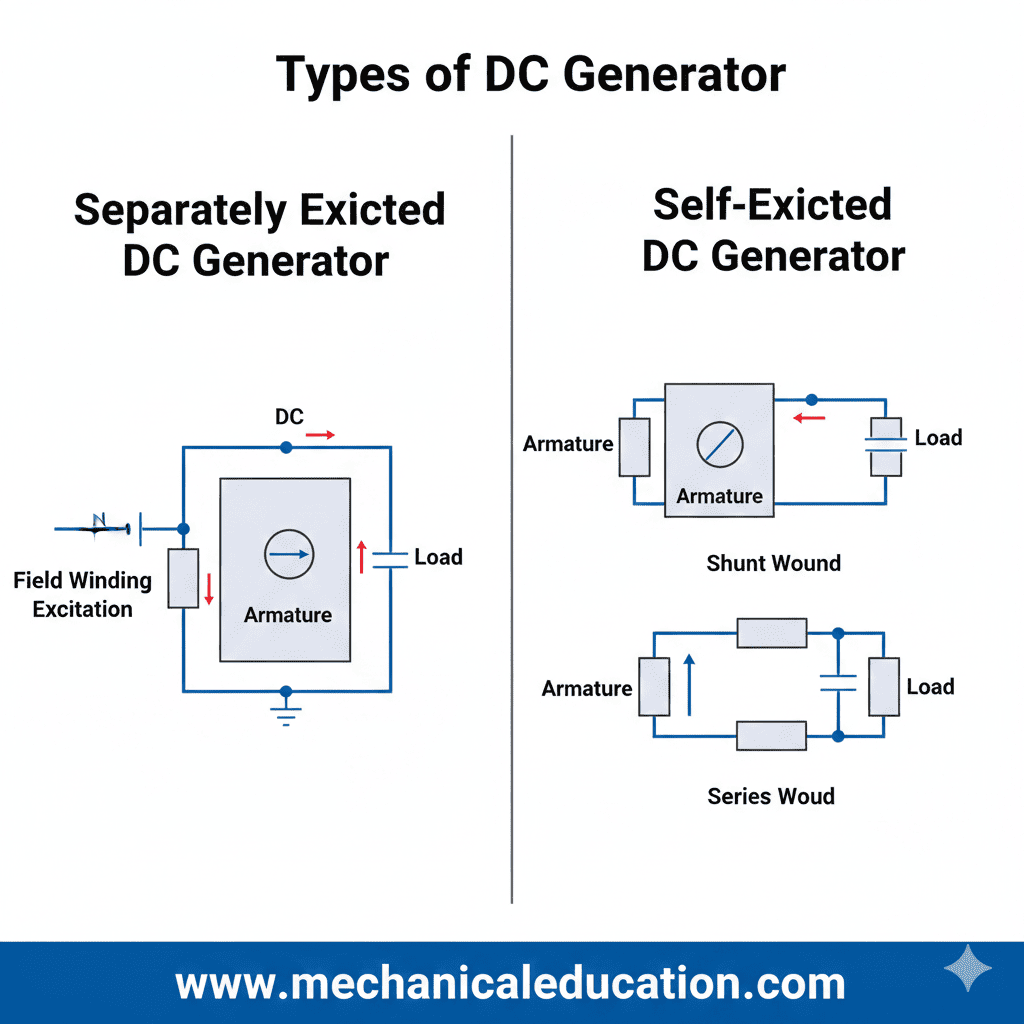
Generators can be classified based on the method of excitation, referring to how the magnetic field in the generator is created. Excitation is the process of providing the necessary magnetic field to induce an electromotive force (EMF) in the armature winding. The two main classifications based on excitation are:
- Separately Excited Generators:
- In separately excited generators, the field winding is supplied with a separate external DC power source, independent of the generator’s output. The field current is controlled by adjusting the voltage applied to the field winding. This type of generator provides good control over the generated voltage and is commonly used in applications where precise voltage regulation is required.
- Self-Excited Generators:
- Self-excited generators have their field winding connected to the generator’s own output, meaning the current for the field winding is derived from the generator’s own output. There are four subtypes of self-excited generators based on the connection of the field winding:
- Shunt-Wound Generator: The field winding is connected in parallel (shunt) with the armature winding.
- Series-Wound Generator: The field winding is connected in series with the armature winding.
- Compound-Wound Generator: Combines both shunt and series field windings.
- Short-Shunt Compound: The shunt field winding is connected in parallel with the armature, and the series field winding is connected in series with the armature.
- Long-Shunt Compound: The shunt field winding is connected in parallel with both the armature and series field winding.
- Self-excited generators have their field winding connected to the generator’s own output, meaning the current for the field winding is derived from the generator’s own output. There are four subtypes of self-excited generators based on the connection of the field winding:
Each type of generator excitation configuration has its own characteristics and applications:
- Shunt-Wound Generators: Provide relatively constant voltage and are used in applications where stable voltage is essential, such as in lighting circuits.
- Series-Wound Generators: Produce high currents and are suitable for applications like electric arc welding.
- Compound-Wound Generators: Combine the characteristics of both shunt and series generators, offering a compromise between voltage regulation and current capacity. Short-shunt and long-shunt configurations provide different performance characteristics.
The choice of generator type depends on the specific requirements of the application, considering factors such as the desired voltage regulation, current capacity, and overall system stability.
What is Separately Excited Generators?
A Separately Excited Generator is a type of DC generator in which the field winding, responsible for creating the magnetic field essential for electromagnetic induction, is powered by a separate and independent DC power source. In other words, the field winding is excited by an external source of electrical power that is distinct from the generator’s output.
Here are the key features and characteristics of Separately Excited Generators:
- Field Winding Source:
- The field winding, typically wound around the pole pieces, is connected to a separate DC power supply. This external power source provides the current needed to create the magnetic field within the generator.
- Control over Excitation:
- The external power supply allows for precise control over the excitation of the generator. By adjusting the voltage or current supplied to the field winding, the strength of the magnetic field can be controlled, influencing the output voltage of the generator.
- Advantages:
- Stability and Precision: Separately excited generators offer excellent stability and precise control over the generated voltage. This makes them suitable for applications where maintaining a constant and accurately regulated voltage is crucial.
- Applications:
- Separately excited generators are commonly used in applications that demand tight voltage regulation, such as in laboratory settings, certain industrial processes, and situations where stable and reliable power is required.
- Control Mechanisms:
- Various control mechanisms, such as automatic voltage regulators (AVRs) or electronic controllers, can be employed to regulate the excitation of the field winding and ensure consistent voltage output.
- Dynamic Response:
- Separately excited generators typically exhibit good dynamic response to changes in load conditions. The external control allows for quick adjustments to maintain stable voltage levels when the load fluctuates.
In summary, Separately Excited Generators offer a high degree of control and stability in voltage regulation by utilizing an external DC power source to excite the field winding. This control makes them well-suited for applications where precise and stable voltage levels are essential.
Advantages of a Separately Excited Generators
Separately Excited Generators offer several advantages, making them suitable for specific applications where precise control over voltage and stability are crucial. Here are some of the key advantages:
- Precise Voltage Regulation:
- One of the primary advantages is the ability to achieve precise voltage regulation. The separate excitation allows for independent control of the field current, enabling the generator to maintain a stable and accurately regulated output voltage.
- Stability in Voltage Output:
- Separately excited generators provide stable voltage output even under varying load conditions. The external control over the field current ensures that the generator can quickly respond to changes in load, maintaining a constant voltage level.
- Flexibility in Applications:
- These generators are well-suited for applications where a constant and accurately regulated voltage is critical, such as in laboratory equipment, sensitive electronic devices, and certain industrial processes.
- Ease of Control:
- The external power supply to the field winding allows for straightforward control mechanisms. Voltage regulators or electronic controllers can be easily implemented to adjust the excitation level, providing fine-tuned control over the generator’s performance.
- Quick Dynamic Response:
- Separately excited generators typically exhibit good dynamic response to load changes. The external excitation control allows for rapid adjustments, ensuring that the generator quickly adapts to fluctuations in the electrical load.
- High Efficiency:
- These generators can operate with high efficiency due to the ability to optimize the excitation level based on the specific requirements of the load. This efficiency is especially important in applications where energy conservation is a priority.
- Versatility in Power Quality:
- Separately excited generators can deliver stable and high-quality power, making them suitable for applications that demand a consistent and reliable power supply without voltage fluctuations or sags.
- Ease of Maintenance:
- The separation of the field winding power source simplifies maintenance procedures. Issues related to the field winding can be addressed independently of the generator’s main output, making maintenance more straightforward.
While Separately Excited Generators have these advantages, it’s important to note that the choice of generator type depends on the specific requirements of the application. The benefits offered by separately excited generators make them valuable in scenarios where precision, stability, and control over voltage are critical.
Disadvantages of a Separately Excited Generators
While Separately Excited Generators have distinct advantages, they also come with certain disadvantages. Understanding these drawbacks is essential for assessing the suitability of such generators for specific applications. Here are some disadvantages associated with Separately Excited Generators:
- Complex Excitation System:
- The need for an external power supply to the field winding adds complexity to the generator’s overall design. The excitation system requires additional components, control circuits, and a separate power source.
- Dependency on External Power Source:
- Separately excited generators rely on an external power supply for the field winding. If this external power source fails or experiences issues, it can lead to a loss of excitation and subsequently affect the generator’s performance.
- Potential for Control System Failure:
- The control system, including devices like voltage regulators, is critical for maintaining stable voltage output. Failures in the control system can lead to voltage instability and impact the generator’s overall reliability.
- Increased Cost:
- The inclusion of an external power supply and control systems can result in higher initial costs for Separately Excited Generators. The additional components and complexity may also contribute to increased maintenance and operational expenses.
- Sensitive to External Disturbances:
- External disturbances or fluctuations in the external power supply can affect the performance of the generator. This sensitivity makes the generator vulnerable to issues in the external power source.
- Slower Response Time:
- In some cases, the response time of the external control system may be slower compared to other excitation methods. This slower response time could impact the generator’s ability to quickly adapt to rapid changes in the load.
- Potential for Over-Excitation:
- If the control system malfunctions or is not properly calibrated, there is a risk of over-excitation. Over-excitation can lead to increased stresses on the generator’s components, potentially causing damage.
- Limited Self-Excitation Capability:
- Separately excited generators may have limited or no ability for self-excitation in the absence of the external power supply. This lack of self-excitation capability can be a disadvantage in certain scenarios.
Despite these disadvantages, it’s essential to note that Separately Excited Generators are still suitable for specific applications where precise voltage control and stability are critical. The choice of generator type should be based on a thorough consideration of the specific requirements and constraints of the intended application.
What is Self-Excited Generators?
Self-excited generators are a type of DC generators where the field winding, responsible for creating the magnetic field necessary for electromagnetic induction, is connected to the generator’s own output. In other words, the generator is capable of producing the required magnetic field for its operation using a portion of its own generated electrical output.
Here are some key points about self-excited generators:
- Self-Excitation Mechanism: In self-excited generators, the initial magnetic field needed for electromagnetic induction is generated by the current flowing through the field winding, which is part of the generator’s own output.
- Start-Up Process: Initially, a small residual magnetism in the magnetic circuit of the generator helps in creating a weak magnetic field. As the armature rotates, a small voltage is induced, and this voltage starts to build up the field current, gradually strengthening the magnetic field.
- Voltage Regulation: The voltage regulation of self-excited generators may not be as precise as that of separately excited generators. The voltage tends to vary with changes in load and speed.
- Applications: Self-excited generators are commonly used in various applications where constant or adjustable voltage output is required. They are often employed in small-scale power generation, portable generators, and certain types of industrial processes.
While self-excited generators are versatile and widely used, their voltage regulation characteristics may require additional measures, such as the use of voltage regulators, to ensure stable and controlled output voltages under varying operating conditions.
Advantages of Self-Excited Generators
Self-excited generators offer several advantages, making them suitable for various applications where simplicity and cost-effectiveness are important considerations.
Here are some key advantages associated with self-excited generators:
- Simplicity of Construction:
- One of the primary advantages is the simplicity of construction. Self-excited generators typically have a straightforward design, which makes them easier to manufacture and maintain.
- Cost-Effectiveness:
- Self-excited generators are generally more cost-effective compared to separately excited generators. The absence of an external power source for field excitation reduces the overall complexity and cost of the generator system.
- Ease of Operation:
- These generators are relatively easy to operate. The self-exciting mechanism allows the generator to initiate its own magnetic field without relying on an external source, simplifying the startup process.
- Versatility in Applications:
- Self-excited generators find applications in a wide range of settings, from small-scale power generation in remote areas to portable generators and certain types of industrial processes. Their versatility makes them suitable for diverse needs.
- Adaptability to Changing Loads:
- Self-excited generators can adapt to changes in load conditions to some extent. While the voltage regulation may not be as precise as in some other types of generators, the self-exciting mechanism allows them to adjust to variations in load.
- Compact Design:
- Due to their simplified construction, self-excited generators can be designed in a compact form factor. This makes them suitable for applications where space is limited or where portability is a key requirement.
- Suitability for Small-Scale Power Generation:
- Self-excited generators are commonly used in small-scale power generation scenarios, such as providing electricity to remote locations, running small appliances, or serving as backup power sources.
- Low Maintenance Requirements:
- The simplicity of design contributes to lower maintenance requirements. While regular maintenance is still necessary, the overall maintenance efforts and costs are generally lower compared to more complex generator systems.
It’s important to note that the advantages of self-excited generators come with certain trade-offs. While they offer simplicity and cost-effectiveness, they may not provide the same level of precision in voltage regulation as separately excited generators. The choice of generator type depends on the specific requirements of the application and the trade-offs that best align with those requirements.
Disadvantages of Self-Excited Generators
While self-excited generators have advantages, they also come with certain disadvantages that should be considered in the selection of a generator type for specific applications. Here are some key disadvantages associated with self-excited generators:
- Limited Voltage Regulation:
- One of the main drawbacks of self-excited generators is their limited voltage regulation. The generated voltage tends to vary with changes in load and speed, making them less suitable for applications requiring precise and stable voltage output.
- Voltage Fluctuations:
- Self-excited generators may exhibit voltage fluctuations, especially under varying load conditions. These fluctuations can impact the reliability of the electrical power supply, making them less suitable for sensitive electronic equipment.
- Difficulty in Controlling Output Voltage:
- Achieving tight control over the output voltage of self-excited generators can be challenging. This limitation is particularly notable in applications where a constant and well-regulated voltage is crucial.
- Sensitive to Load Changes:
- Self-excited generators are often sensitive to changes in the load, and the voltage output may not respond quickly or predictably to sudden load variations. This can lead to inconsistencies in the power supply.
- Risk of Voltage Instabilities:
- In certain conditions, self-excited generators may experience voltage instabilities, such as overvoltage or undervoltage situations. This can occur if the system is not carefully designed or if load conditions change rapidly.
- Lack of Initial Excitation:
- During startup, self-excited generators rely on residual magnetism to initiate the excitation process. If there is insufficient residual magnetism, an external source may be required to provide initial excitation.
- Lower Efficiency:
- In some cases, self-excited generators may have lower overall efficiency compared to other types of generators. The self-excitation process and the associated voltage fluctuations can contribute to energy losses.
- Complex Design for Improved Regulation:
- To enhance voltage regulation in self-excited generators, additional components such as voltage regulators may be needed. This can increase the complexity and cost of the overall generator system.
- Unstable Operation at Low Loads:
- Self-excited generators may experience unstable operation, especially at low loads. This instability can result in poor performance and reliability in applications where the load varies widely.
- Unsuitable for High-Precision Applications:
- Due to their limitations in voltage regulation and control, self-excited generators are generally unsuitable for applications that require high precision and stability in the electrical power supply.
Despite these disadvantages, self-excited generators remain valuable in certain applications, especially those where simplicity, cost-effectiveness, and moderate voltage regulation are acceptable trade-offs. The choice of generator type should be carefully considered based on the specific needs and constraints of the intended application.
Frequently Asked Questions
1.What is the primary classification of generators based on excitation?
Generators are classified into two main categories based on excitation: Separately Excited Generators and Self-Excited Generators.
2.How does a Separately Excited Generator differ from a Self-Excited Generator?
In Separately Excited Generators, the field winding is powered by an external DC source, while in Self-Excited Generators, the field winding is connected to the generator’s own output.
3.What are the subtypes of Self-Excited Generators based on field winding connection?
Self-Excited Generators have subtypes: Shunt-Wound Generators, Series-Wound Generators, and Compound-Wound Generators (Short-Shunt and Long-Shunt configurations).
4.How is the field winding connected in Shunt-Wound Generators?
In Shunt-Wound Generators, the field winding is connected in parallel (shunt) with the armature winding.
5.What are the characteristics of Separately Excited Generators?
Separately Excited Generators offer excellent voltage regulation, stability, and precise control over excitation due to an external power source for the field winding.
6.Why are Series-Wound Generators suitable for certain applications?
Series-Wound Generators are suitable for applications requiring high currents, such as electric arc welding, due to their series connection of the field winding.
7.What is the purpose of the compound winding in Compound-Wound Generators?
Compound-Wound Generators use both shunt and series field windings to combine the characteristics of both types, providing a balance between voltage regulation and current capacity.
8.How do Self-Excited Generators initiate their own excitation?
Self-Excited Generators utilize residual magnetism to initiate a weak magnetic field. As the armature rotates, a small voltage is induced, gradually building up the field current.
9.Why are Self-Excited Generators considered cost-effective?
Self-Excited Generators are often more cost-effective due to their simpler construction and the absence of an external power source for field excitation.
10.In which applications are Separately Excited Generators commonly used?
Separately Excited Generators are commonly used in applications where precise voltage regulation, stability, and control are critical, such as in laboratories and certain industrial processes.