What is Electromechanical Energy Conversion?
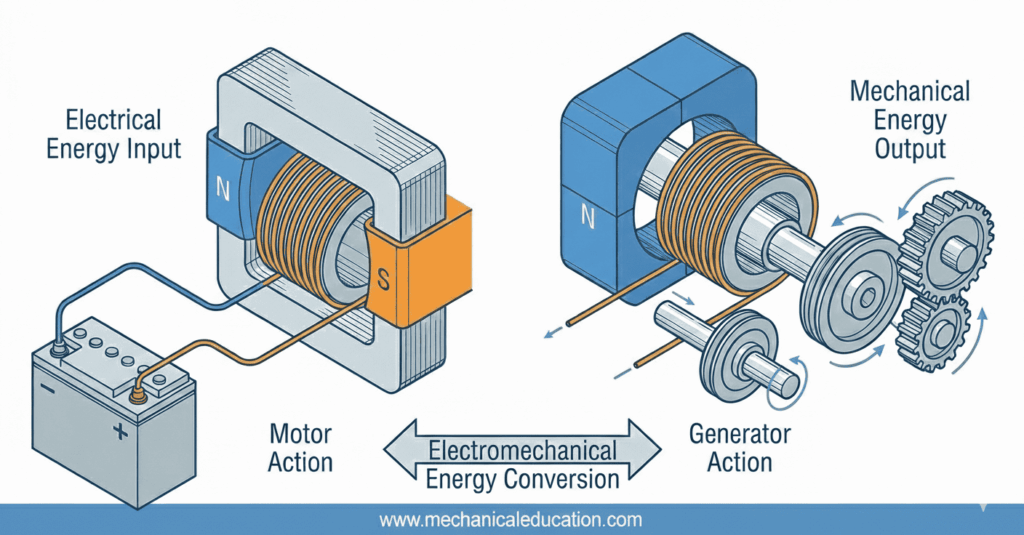
Electro-mechanical energy conversion is the process of converting electrical energy into mechanical energy or vice versa. This conversion is essential in various devices and systems where it is necessary to transfer energy between electrical and mechanical forms. Two primary processes characterize electro-mechanical energy conversion: electrical-to-mechanical conversion and mechanical-to-electrical conversion.
- Electrical-to-Mechanical Conversion:
- Motor Operation: In this process, electrical energy is converted into mechanical energy. Electric motors, such as those found in appliances, industrial machinery, or electric vehicles, are common examples. The motor utilizes the interaction between a magnetic field and an electric current to generate mechanical motion.
- Mechanical-to-Electrical Conversion:
- Generator Operation: This process involves converting mechanical energy into electrical energy. Generators, also known as alternators, are devices that produce electrical power through the relative motion of conductors within a magnetic field. This is commonly used in power generation, where mechanical energy (often from turbines) is converted into electricity.
Key Concepts:
- Faraday’s Law: The basis of electro-mechanical energy conversion lies in Faraday’s law of electromagnetic induction, which states that a change in magnetic flux through a conductor induces an electromotive force (EMF) or voltage.
- Lenz’s Law: Lenz’s law dictates that the direction of the induced current opposes the change in magnetic flux, ensuring that the energy conversion processes follow a consistent direction.
- Applications:
- Motors: Used in various applications, from household appliances to industrial machinery, converting electrical energy into mechanical work.
- Generators: Commonly employed in power plants and other energy systems, converting mechanical energy into electrical energy.
- Efficiency: Electro-mechanical energy conversion processes are not 100% efficient, and factors such as friction, heat losses, and resistance contribute to energy losses during the conversion.
In summary, electro-mechanical energy conversion plays a crucial role in various technologies, facilitating the seamless integration of electrical and mechanical systems in everyday life and industrial applications.
Principles of Electromechanical Energy Conversion
The principles of electro-mechanical energy conversion are based on fundamental laws of electromagnetism and the interaction between electrical and mechanical systems. Here are the key principles involved in the electro-mechanical energy conversion process:
- Faraday’s Law of Electromagnetic Induction:
- Principle: A change in magnetic flux through a conductor induces an electromotive force (EMF) in the conductor.
- Application: Essential for understanding the generation of voltage in generators and the operation of transformers.
- Lenz’s Law:
- Principle: The direction of the induced current (or EMF) is such that it opposes the change in magnetic flux that produced it.
- Application: Governs the direction of the induced current in motors and generators, ensuring consistency in the conversion process.
- Ampere’s Law:
- Principle: The magnetic field produced around a conductor carrying an electric current is directly proportional to the current flowing through the conductor.
- Application: Relevant in designing the magnetic components of motors and generators.
- Lorentz Force Law:
- Principle: Describes the force experienced by a charged particle moving through a magnetic field.
- Application: Governs the motion of charged particles (electrons) in conductors within a magnetic field, influencing the mechanical behavior of devices like motors.
- Conservation of Energy:
- Principle: Energy cannot be created or destroyed, only converted from one form to another.
- Application: Ensures that the total energy input (electrical and mechanical) is equal to the total energy output during the conversion process, accounting for losses.
- Mechanical Power and Torque:
- Principle: Power is the rate at which work is done or energy is transferred. Torque is the turning force that causes rotation.
- Application: Relates the mechanical output of a system (e.g., a motor) to its electrical input, considering factors like speed and torque.
- Maxwell’s Equations:
- Principle: A set of equations that describe the relationship between electric and magnetic fields, providing a comprehensive understanding of electromagnetism.
- Application: Used in the theoretical analysis and design of electro-mechanical devices.
- Efficiency:
- Principle: The ratio of useful output energy to the input energy, often expressed as a percentage.
- Application: Evaluates the effectiveness of electro-mechanical energy conversion devices, considering losses such as heat, friction, and electrical resistance.
Understanding and applying these principles is crucial for the design, analysis, and optimization of devices involved in electro-mechanical energy conversion, including electric motors, generators, transformers, and other related systems.
Types of Electromechanical Energy Conversion
Electro-mechanical energy conversion involves the transformation of energy between electrical and mechanical forms. Various devices and systems are designed for this purpose, and they can be broadly categorized into types based on their specific applications. Here are some common types of electro-mechanical energy conversion devices:
- Electric Motors:
- Principle: Converts electrical energy into mechanical energy.
- Application: Used in a wide range of appliances, industrial machinery, and transportation (e.g., electric vehicles).
- Generators (Alternators):
- Principle: Converts mechanical energy into electrical energy through electromagnetic induction.
- Application: Essential in power plants for electricity generation, as well as in various portable generators.
- Transformers:
- Principle: Transfers electrical energy between two or more coils through electromagnetic induction.
- Application: Used for voltage transformation in power distribution networks, minimizing energy losses during transmission.
- Linear Motors:
- Principle: Similar to rotary electric motors, but the movement is linear instead of rotational.
- Application: Employed in applications where linear motion is required, such as in maglev trains or positioning systems.
- Piezoelectric Devices:
- Principle: Utilizes the piezoelectric effect to convert mechanical stress or vibration into electrical charge or vice versa.
- Application: Commonly used in sensors, actuators, and energy harvesting devices.
- Solenoids:
- Principle: Converts electrical energy into linear motion by the magnetic field generated when current flows through a coil.
- Application: Found in various electromechanical devices, such as door locks, valves, and relays.
- Piezoelectric Transducers:
- Principle: Converts electrical energy into ultrasonic or mechanical vibrations.
- Application: Used in medical imaging (ultrasound), sensors, and various industrial applications.
- Electric Generators in Wind Turbines:
- Principle: Converts the kinetic energy of wind into mechanical energy, and then into electrical energy through a generator.
- Application: Harvests wind energy for electricity generation in wind power plants.
- Electro-Mechanical Actuators:
- Principle: Converts electrical signals into mechanical motion for precise control.
- Application: Commonly used in robotics, aerospace systems, and industrial automation.
- Piezoelectric Motors:
- Principle: Utilizes the piezoelectric effect for fine and precise mechanical motion.
- Application: Used in applications where high precision and compact size are essential, such as in optics and nano-positioning systems.
These types of electro-mechanical energy conversion devices play crucial roles in various industries and technologies, contributing to the efficient utilization of electrical and mechanical energy in a wide range of applications.
Frequently Asked Questions
1.What is electro-mechanical energy conversion?
Electro-mechanical energy conversion is the process of transforming energy between electrical and mechanical forms, involving devices and systems that either convert electrical energy into mechanical energy (e.g., electric motors) or mechanical energy into electrical energy (e.g., generators).
2.How does an electric motor work in electro-mechanical energy conversion?
An electric motor converts electrical energy into mechanical energy by utilizing the interaction between a magnetic field and an electric current. This interaction results in the generation of rotational motion.
3.What role do generators play in electro-mechanical energy conversion?
Generators, or alternators, are crucial in converting mechanical energy into electrical energy through the principle of electromagnetic induction. They play a key role in electricity generation in power plants.
4.How do transformers contribute to electro-mechanical energy conversion?
Transformers transfer electrical energy between coils through electromagnetic induction, allowing for voltage transformation. They are essential in power distribution networks for minimizing energy losses during transmission.
5.What are piezoelectric devices in electro-mechanical energy conversion?
Piezoelectric devices utilize the piezoelectric effect to convert mechanical stress or vibration into electrical charge and vice versa. They find applications in sensors, actuators, and energy harvesting systems.
6.In what applications are linear motors used?
Linear motors, similar to rotary electric motors but producing linear motion, are used in applications where precise linear movement is required, such as in maglev trains and positioning systems.
7.How do piezoelectric transducers function in electro-mechanical energy conversion?
Piezoelectric transducers convert electrical energy into ultrasonic or mechanical vibrations. They are commonly used in medical imaging (ultrasound), sensors, and industrial applications.
8.What is the role of electro-mechanical actuators?
Electro-mechanical actuators convert electrical signals into mechanical motion for precise control. They find applications in robotics, aerospace systems, and industrial automation.
9.How does electro-mechanical energy conversion contribute to renewable energy?
Electro-mechanical energy conversion is crucial in renewable energy applications, such as wind turbines. These systems convert the kinetic energy of wind into mechanical and then electrical energy.
10.What distinguishes solenoids in electro-mechanical systems?
Solenoids convert electrical energy into linear motion through the magnetic field generated by the flow of current through a coil. They are commonly found in devices like door locks, valves, and relays.